
The most useful capital gains planning often happens before a sale closes. After an asset is sold or a transaction becomes binding, some planning options may be limited, which is why timing and structure deserve review before you act. After the transaction, the focus shifts to calculating and reporting the gain.
For entrepreneurs and investors carrying a large appreciated position, that is the hard part: some strategies need lead time, particularly when they involve a business sale, property transaction, charitable structure, or account-level planning. Below is how capital gains tax actually works, the legal ways to reduce or defer it, and how the pieces fit together over several years rather than in a frantic week each December.
This is general education, not personalized tax or legal advice. Rates, thresholds, and program rules change, so confirm the current-year numbers for your own situation with your CPA before acting.
If you are planning around a business sale, property sale, or concentrated investment position, our capital-gains planning explains how this work fits into a broader wealth plan.
Quick Answer: Legal Ways to Reduce or Defer Capital Gains Tax
Depending on the asset, timing, income, and transaction structure, planning may include:
- Reviewing whether holding the asset longer could affect its tax treatment.
- Using eligible capital losses to offset capital gains.
- Timing a sale or eligible installment transaction across tax years.
- Reviewing qualifying home-sale exclusions, 1031 exchanges, charitable gifts, or other specialized rules.
- Coordinating the decision with your CPA, tax attorney, qualified intermediary, and wealth advisor when appropriate.
These strategies do not automatically erase tax. Some reduce or offset a current liability, while others defer recognition or apply only when strict eligibility rules are met.
Capital Gains Tax Basics: When a Gain Becomes Taxable
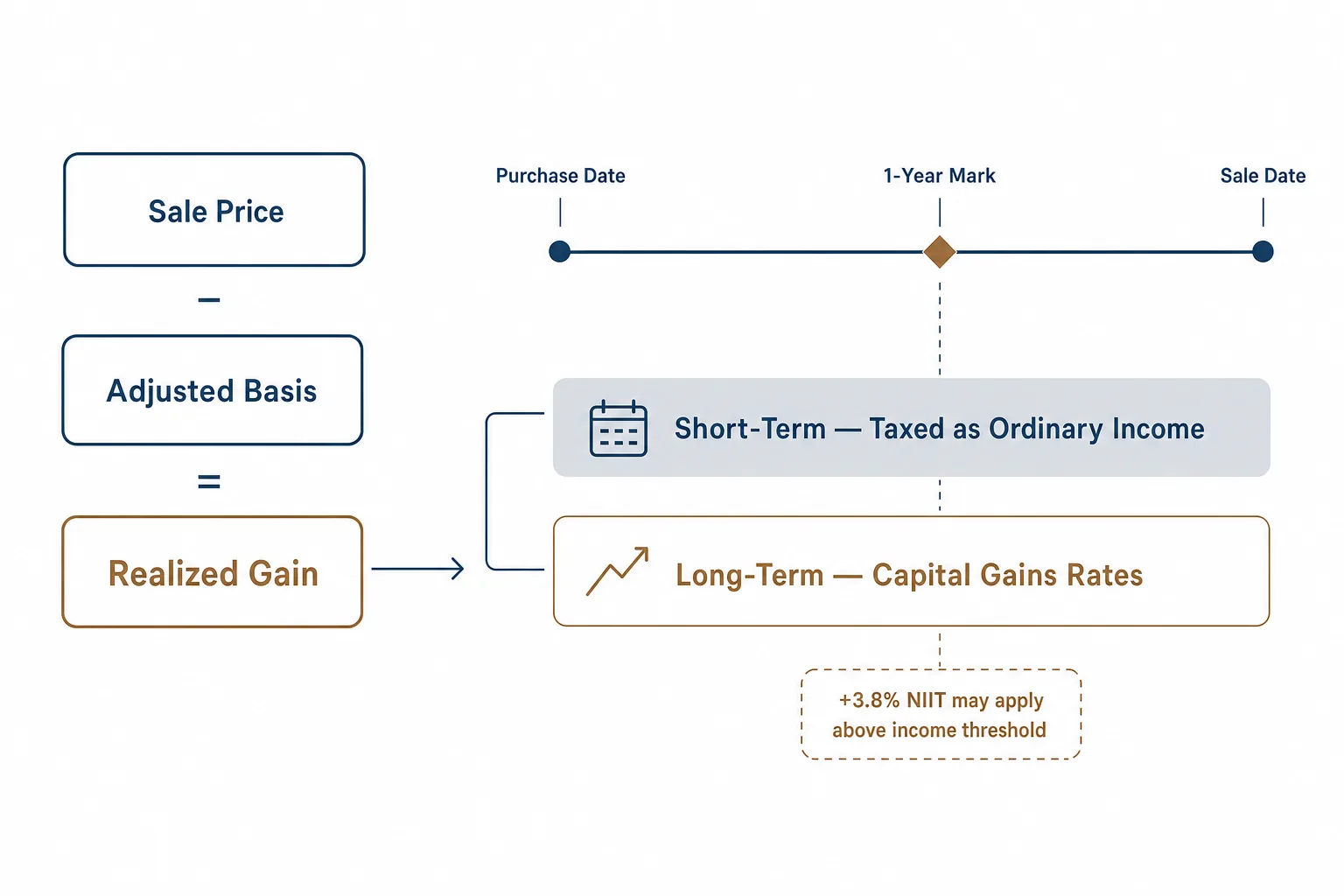
A capital gain generally starts with the amount realized minus your adjusted basis. Basis is asset-specific and may reflect items such as purchase cost, eligible improvements, reinvested distributions, depreciation, and transaction expenses. Appreciation alone is not generally taxable. A gain becomes a realized gain, and therefore a potential taxable event, when you sell or exchange the asset. See IRS Topic 409 for the federal framework.
The holding period generally affects whether a gain is short-term or long-term. Assets held for one year or less are generally taxed at ordinary income rates, while assets held for more than one year may qualify for long-term federal rates. The applicable rate depends on taxable income, filing status, asset type, and current-year thresholds.
Related readingHow Do I Avoid Lifestyle Deflation After a Business SaleRead the guide →The 3.8% Net Investment Income Tax (NIIT) may apply to the lesser of net investment income or the amount by which modified adjusted gross income exceeds the applicable threshold: $200,000 for single or head-of-household filers, $250,000 for married couples filing jointly, and $125,000 for married couples filing separately. See IRS Topic 559. North Carolina generally includes capital gains in individual taxable income, so use the current NCDOR rate schedule for the year of the sale.
So how much capital gains tax would you pay on $300,000? There is no single answer, which is why online calculators need context. Illustration only: if the entire $300,000 were taxed at a 15% federal long-term capital-gain rate, the arithmetic would be $45,000 before filing status, taxable-income thresholds, NIIT, state tax, basis, and other return items. If the same $300,000 is a short-term gain, it stacks onto ordinary income and is taxed at ordinary rates, which may be higher. The same dollar amount can produce materially different outcomes based on holding period, filing status, total taxable income, asset type, and state residency.
Strategy 1: Consider the Holding Period

Time can affect the federal treatment of a gain. Holding an asset for more than one year may qualify it for long-term treatment, but the financial benefit depends on your taxable income, filing status, state, and the asset itself. Waiting also exposes you to market and transaction risk.
If a holding is approaching its first anniversary and you do not need the cash immediately, waiting may change the tax treatment, but it is not automatically the right investment decision. Tax efficiency is one input into a sell decision, not the decision itself.
Strategy 2: Use Capital Losses to Offset Gains
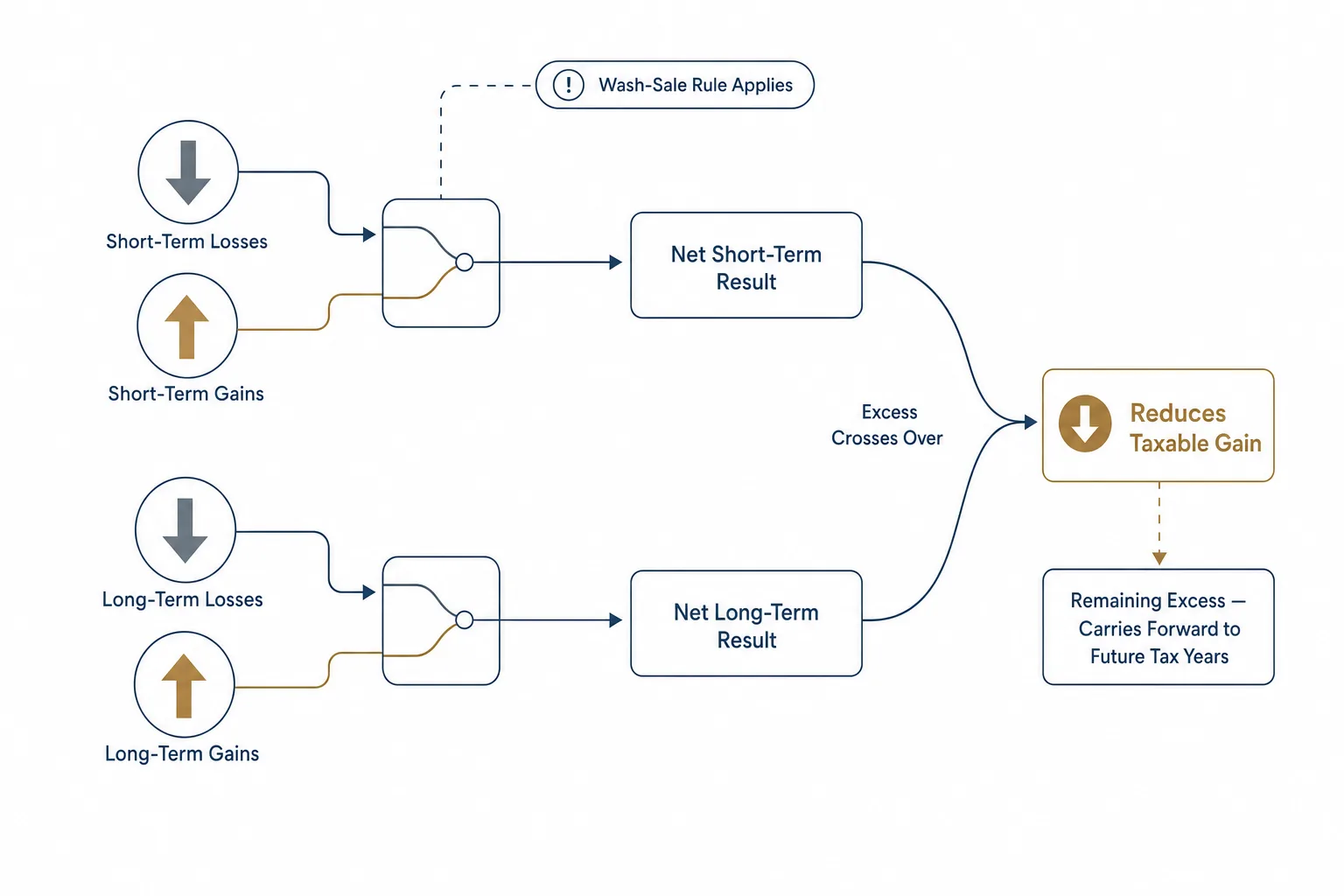
After required netting, allowable capital losses may offset capital gains; an excess net loss is generally subject to federal deduction limits and carryforward rules. Short-term losses net against short-term gains first, long-term losses against long-term gains, and any remainder crosses over.
Two practical points often get missed. First, the wash-sale rule may disallow a loss if you buy the same or a substantially identical security within the applicable window before or after the sale. Related accounts, a spouse’s account, and IRA transactions can affect the analysis, so confirm the facts with a tax professional and review IRS Publication 550.
Second, harvesting opportunities appear when markets are down, not when your calendar says December. A year-round review can identify opportunities that are not visible at a single year-end review. Loss carryforwards can be useful in a later year with eligible gains, including a business sale, but their value depends on timing, character, and the rest of the tax return.
Strategy 3: Consider the Timing of Gain Recognition
Long-term rates are bracket-driven, so the rate you pay depends on your total taxable income in the year you sell. Recognizing a gain in a low-income year can move part of it into the 0% or 15% band.
Low-income years are more common than people assume: a sabbatical, the gap between selling one business and starting the next, or the early retirement window after you stop working but before Social Security and required minimum distributions begin. For eligible transactions, an installment sale may spread gain recognition across the years in which payments are received, but it does not apply to every asset or transaction. Review IRS Publication 537 before relying on this treatment.
Roth conversions, RMDs, and gain recognition all compete for the same bracket space in the same years.
Here is the coordination problem. Roth conversions, RMDs, and gain recognition all compete for the same bracket space in the same years. Fill that space with a Roth conversion, and you have less room for gains at favorable rates, and the reverse is equally true. You cannot solve that with a single-year decision, which is why it belongs in a multi-year plan. This is also where retirement planning can connect with capital-gains planning: withdrawals, conversions, and sales may compete for the same tax brackets.
Strategy 4: Review Asset Location and Cost Basis
Asset location can be part of tax planning. Sales inside retirement accounts are generally not reported as capital gains within the account, but traditional-account distributions are generally taxed as ordinary income; Roth treatment depends on whether the distribution is qualified. Whether a holding belongs in a taxable or retirement account depends on liquidity, risk, tax treatment, and the overall plan.
For investors with appreciated assets, tax-coordinated investment management can be one part of reviewing account location, basis, and the timing of sales.
Two details worth insisting on with your custodian:
- Specific-lot identification. When you sell part of a position, the default method may use first-in, first-out treatment, depending on the asset and custodian. Identifying specific lots before the sale may help manage the realized gain.
- Step-up in basis at death. Assets held until death may receive a basis adjustment, subject to current law and the facts of the estate. For some deeply appreciated holdings, the decision may be to coordinate the position with the estate plan rather than sell immediately.
Strategy 5: Capital-Gains Strategies for Real Estate
Real estate carries its own rules, and applying them requires attention to basis, depreciation recapture, use, and timing.
The Primary Residence Exclusion
If you owned the home and used it as your main residence for at least two of the five years before the sale, you may generally qualify to exclude up to $250,000 of gain as a single filer or $500,000 when filing jointly. The two years of use do not have to be consecutive. The exclusion is generally available no more than once every two years, and partial exclusions may apply in certain circumstances. Review IRS Topic 701 and Publication 523 for the applicable requirements.
1031 Exchanges for Investment Property
A Section 1031 like-kind exchange may allow you to defer gain by moving from one qualifying investment or business-use real property to another. Defer does not mean erase: basis generally carries into the replacement property, and the tax may be recognized later.
The deadlines are strict. You generally have 45 days after the transfer to identify replacement property and must receive the replacement property by the earlier of 180 days after the transfer or the due date of the return for that year, including extensions. A qualified intermediary typically holds the proceeds, and constructive receipt rules can disqualify the exchange. Review the IRS Form 8824 instructions before closing. Section 1031 applies to qualifying real property, not a primary residence.
Depreciation recapture is a separate calculation for many rental-property sales. Depreciation deductions reduce basis, and the resulting gain may be taxed under rules different from the long-term capital-gain rate. Include it when estimating net proceeds.
Delaware Statutory Trusts and Opportunity Zones
A Delaware Statutory Trust may be considered as replacement property in some properly structured 1031 transactions, but eligibility, liquidity, fees, sponsor risk, and suitability require separate review. It should not be presented as an automatic backup or a universal solution.
Qualified Opportunity Funds work differently from 1031 exchanges. An eligible gain may be invested within an applicable period, but the deferral period, recognition date, holding requirements, and program rules depend on current law. Because Opportunity Zone rules and deadlines have changed, confirm the current requirements through IRS QOF guidance before relying on this strategy.
Strategy 6: Consider Charitable Giving for Appreciated Assets
Donating eligible long-term appreciated securities directly to a qualified charity, rather than selling and donating cash, generally avoids recognition of the embedded gain, subject to holding-period, deduction, valuation, and substantiation rules. Review IRS Publication 526 and confirm the treatment with your tax professional. If you already give to a church or local cause in Raleigh, directing eligible appreciated securities instead of cash may be worth discussing.
A donor-advised fund may allow a deduction in a high-income year, such as the year of a business sale, followed by grants over later years. A charitable remainder trust may provide an income stream while deferring recognition in certain structures, but it is complex and not universally suitable. Gifting appreciated shares to family members can shift tax consequences rather than eliminate them, with kiddie-tax, basis, and gift-tax rules to consider.
Strategy 7: Plan a Business Sale Before the Transaction Is Set
Owners approaching a liquidity event face a different planning context from investors selling shares, and the timing can be more consequential.
Whether the transaction is structured as an asset sale or a stock sale may affect the character and amount of the gain, but the result depends on the deal terms and the owner’s tax position. Some qualifying C corporation stock may receive gain exclusion under current Section 1202 rules; acquisition date, holding period, issuer, active-business, and limitation requirements matter.
Review IRS Publication 550 and obtain current tax-attorney guidance before relying on QSBS treatment. Installment sales, earnouts, and escrow-release timing may shift income across tax years, which connects with Strategy 3. This is where business succession planning can connect with capital-gains planning.
For a related discussion, read our tax implications of selling a small business before retirement guide.
How far in advance should you start planning to sell your business? Starting several years before a potential sale may leave more time to evaluate entity structure, basis, transaction structure, charitable planning, installment treatment, and post-sale needs. Once a transaction becomes binding, some options may be narrower, so coordinate with your CPA and attorney before signing.
What These Strategies Can and Cannot Do
| Planning goal | What it means |
|---|---|
| Reduce | Lower the amount or rate of tax that may apply under the facts of the transaction. |
| Offset | Use eligible capital losses against capital gains, subject to netting and carryforward rules. |
| Defer | Move recognition of an eligible gain to a later tax year under specific requirements. |
| Exclude | Leave qualifying gain out of taxable income under a specific provision, such as an eligible home-sale or QSBS rule. |
| What does not work automatically? | Simply reinvesting sale proceeds does not generally erase a gain that has already been realized. |
Common Capital-Gains Planning Mistakes
- Holding a concentrated position indefinitely purely to avoid the bill can expose you to investment risk that may outweigh the potential tax benefit.
- Modeling proceeds without depreciation recapture, the 3.8% surtax, or state tax
- Triggering a wash sale through a related account without reviewing the applicable rules
- Missing a 45-day identification deadline, or taking constructive receipt of exchange proceeds
- Treating these strategies as independent tactics rather than one sequence
- Relying on an old rate, deadline, or program rule without checking the current tax year
Build a Multi-Year Capital-Gains Plan
Every strategy here interacts with the others. Harvested losses can be most useful in a year with eligible gains. Gain recognition competes with Roth conversions for bracket space. A 1031 exchange can defer tax into a future year that also has to absorb RMDs. The value is in sequencing the options against your income, liquidity needs, and retirement timeline.
That is what comprehensive planning can look like in practice: a full picture of the accounts and holdings you own, a cash-flow analysis, a written plan showing how the pieces fit, and adjustments as circumstances change. Tax strategy should be coordinated with the broader investment, retirement, estate, and succession plan rather than treated as an isolated tactic.
Again, none of this is personalized tax or legal advice. The right approach depends on facts we would need to see, and it should be coordinated with your CPA and attorney.
Reporting and Recordkeeping
For many stock, fund, and other capital-asset sales, your tax return may require information from brokerage statements, Form 8949, and Schedule D. Check the basis, proceeds, holding period, and adjustments before filing; IRS Form 8949 guidance explains the form’s purpose. Different transactions may require different reporting, including Form 8824 for a like-kind exchange or Form 6252 for an installment sale. Ask your CPA or tax attorney which forms apply to your facts.
Capital Gains Tax FAQs
Is it possible to reduce capital gains tax?
How can I reduce my capital gains tax this year specifically?
What is the best way to reduce capital gains?
Can I avoid capital gains tax on stocks entirely?
How do I reduce capital gains tax on the sale of a rental property?
Does reinvesting sale proceeds avoid capital gains tax?
Can I reduce capital gains tax after selling?
How can a business owner reduce capital gains tax on a sale?
Which professionals should I involve in capital-gains planning?
Are capital gains tax calculators reliable?
Discuss Your Capital-Gains Planning Needs
Interest in this topic often rises when markets are volatile, around tax season, and at year-end. Those are reasonable times to review your situation, but an earlier review, before a sale is on the calendar, may leave more planning options available.
If you are carrying a concentrated position, weighing a property sale, or thinking about an exit from your business in the next few years, we can begin with a conversation about your current statements, cash flow, expected transaction, and financial outlook. If further planning is appropriate, Weston Banks can explain the scope and any applicable fees before you decide how to proceed.
You can read more about What We Do, get to know the team through Who We Are, and browse the Education section for more planning topics. If you would like to discuss your situation, book a Consultation.